
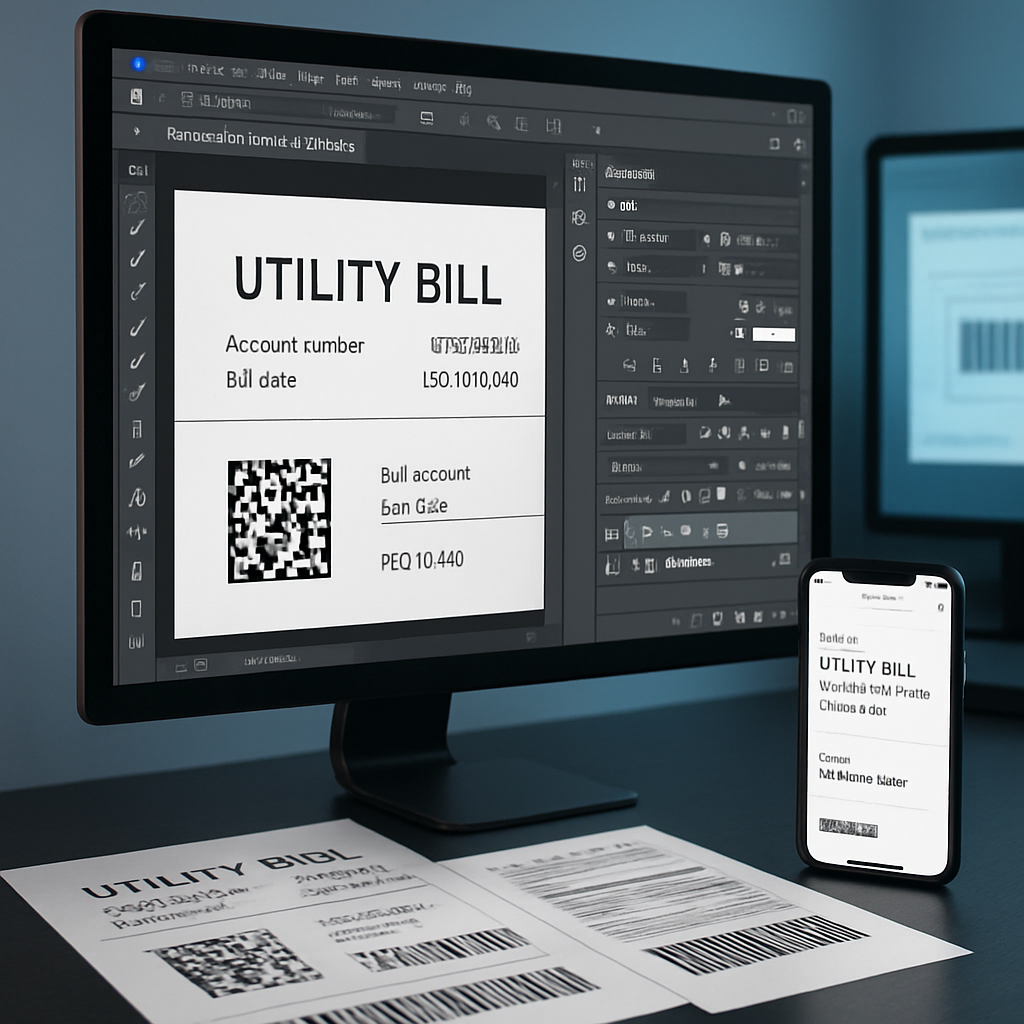
Working with utility bill PSD templates demands precision, especially when matching fonts and generating barcodes. Achieving consistent design accuracy and clean exports ensures your edits maintain a professional, polished layout while saving valuable time.
This guide on how to edit utility bill PSD files will walk you through essential techniques for identifying fonts using tools like WhatTheFont and creating accurate 2D barcodes such as DataMatrix and PDF417. By mastering these steps, you can enhance the realism and consistency of your utility bill PSD templates, making future adjustments faster and more reliable.
Let’s explore how to navigate PSD layers effectively, match fonts precisely, and generate barcodes correctly to elevate your utility bill PSD editing workflow. These templates are intended for design practice, mockups, and film props; they are not substitutes for official documents.
Editing a utility bill PSD requires precise font matching and accurate barcode generation to produce professional, realistic results. This guide focuses on key techniques for handling these crucial elements effectively.
- Open and navigate utility bill PSD files in Photoshop: Understand layer structures for efficient text and graphic edits.
- Use WhatTheFont for precise font identification: Match fonts exactly to maintain the authentic look of the utility bill.
- Generate accurate 2D barcodes (DataMatrix, PDF417): Employ specialized tools to create barcodes that adhere to real-world utility bill standards.
- Maintain layout consistency and design realism: Align fonts and barcodes carefully to preserve the document’s professional appearance.
- Leverage step-by-step PSD editing tutorials: Follow structured instructions for modifying text and graphics without distorting the original design.
- Hidden insight—prioritize barcode authenticity: Correct generation of barcodes is often overlooked but essential for a credible utility bill mockup.
Next, we will explore detailed methods for font matching and barcode creation, enabling you to enhance your utility bill PSDs with authenticity and precision. These templates are intended for design practice, mockups, and film props; they are not substitutes for official documents.
Opening and Navigating Utility Bill PSD Files in Photoshop
Unlocking the full potential of utility bill PSD templates starts with understanding their internal structure and organization. These layered files separate text, logos, graphics, and backgrounds into manageable elements, enabling precise editing without compromising overall design integrity.
Understanding PSD Layers for Text and Graphics
Begin by examining the Layers panel closely. Editable text layers are typically labeled clearly and distinguished by a “T” icon. Unlike rasterized image layers or shapes, text layers allow direct editing of content, fonts, and styles. Be sure to:
- Identify locked layers (usually background or template guides) and unlock only when necessary to prevent accidental changes.
- Distinguish between vector shapes used for logos or borders and raster layers containing scanned images or effects.
- Organize the layer hierarchy by using groups and well-structured naming conventions such as “Account_Info,” “Meter_Data,” or “Barcodes”. This approach streamlines navigation and editing, especially with complex multi-page PSD files.
Best Practices for Editing Text in Utility Bill PSD Templates
For efficient text editing without disrupting the template’s design:
- Select the Text tool (T) and click directly on editable text layers to modify content.
- Maintain font consistency by checking and replicating original font styles and sizes from the Character panel.
- Utilize paragraph and character styles where available to ensure uniform formatting across multiple fields, such as account numbers or billing dates.
- Save your work as layered PSD files, preserving editability for future revisions.
For professionally designed PSD templates that reduce setup time and enhance editing ease, consider exploring our utility bill template collection. These templates often feature well-organized layers and placeholder text optimized for quick updates.
How to Identify and Match Fonts in Utility Bill PSD
Accurate font matching maintains the authenticity and professional look of your utility bill edits. Mismatched fonts can break visual consistency and reduce the realism of your mockups.
Using WhatTheFont for Precise Font Identification
A reliable method for identifying fonts embedded in PSD files involves extracting screenshot samples of text segments and analyzing them with online tools like WhatTheFont:
- Open the PSD and zoom into the text area you want to identify.
- Take a clean screenshot or export the text layer as an image.
- Upload this image to the WhatTheFont website or mobile app.
- Review the suggested font matches based on visual similarity.
- Consider slight variations in font styles and weights as WhatTheFont may suggest close alternatives rather than exact fonts.
Tips for Matching Fonts Correctly in Utility Bill PSD
After initial identification, refine font matching by:
- Manually comparing font weights, sizes, and letter spacing (tracking) against the original template text in Photoshop.
- Utilizing Adobe Fonts or other reputable font libraries to source and activate the identified or similar font styles.
- Saving these fonts within your editing environment to maintain consistency when replacing or adding text layers.
For templates optimized around font scalability and easy font swapping, check out our editable utility bill templates designed for global use.
Generating Accurate 2D Barcodes for Utility Bills
Adding barcodes that resemble real-world standards enhances the credibility of your utility bill mockups. Common 2D barcodes such as DataMatrix and PDF417 encode billing or customer information compactly and are widely recognized in the utilities industry.
Overview of 2D Barcode Types: DataMatrix and PDF417
Both DataMatrix and PDF417 serve unique roles in utility documentation:
- DataMatrix: A square or rectangular matrix barcode ideal for small spaces, highly readable by scanners and used for asset tracking or meter readings.
- PDF417: A stacked linear barcode capable of encoding large data volumes, frequently used for customer account info and billing details due to its dense information capacity.
Tools and Steps for Generating Utility Bill Barcodes
To create and integrate accurate barcodes into your PSD templates, follow these steps:
- Select reliable barcode generators compatible with your preferred barcode type (e.g., online generators, Adobe Illustrator plugins, or specialized software like ZebraDesigner).
- Input the exact data required for the barcode—account numbers, billing references, or dates—to maintain realistic content.
- Configure size, resolution (minimum 300 dpi for print quality), and error correction settings to ensure scan reliability.
- Export barcode images in high-resolution PNG or TIFF formats to preserve transparency and quality when importing to PSD files.
- Place barcode images on designated placeholder barcode layers, adjusting alignment and size carefully.
Explore our detailed guide on tools for editing utility bill PSD templates, which includes tips for flawless barcode generation and integration.
Maintaining Layout Consistency and Design Realism
Consistent alignment and integrated design elements create realistic, professional utility bill mockups that stand up under scrutiny.
Aligning Text and Graphic Elements in Photoshop
Precise placement of text and graphic elements like barcodes ensures visual harmony:
- Activate rulers and enable grid and snap-to guides to align elements quickly and accurately.
- Use smart guides to dynamically match spacing between text layers and barcode graphics, mimicking the original spacing conventions of authentic utility bills.
- Verify color accuracy by sampling text and barcode colors from the original PSD or reference scans, retaining consistent grayscale or color profiles.
- Check margins and padding inside tables or summary boxes to prevent text crowding or overlap with graphics.
Exporting Clean, High-Quality Utility Bill PSD Edits
After completing edits, export your utility bill mockups thoughtfully to maintain quality for print or digital use:
- Save master versions as layered PSD files to preserve edit flexibility.
- Export flattened TIFF or PDF files with 300 dpi resolution for print-ready submissions.
- Use high-quality JPEG or PNG exports optimized for web or email distribution.
- Perform quality checks by zooming in to 100% and reviewing all details for pixelation, color shifts, or layout inconsistencies.
For templates that facilitate professional workflows with realistic design elements, browse PSD utility bill templates such as the United States Central Hudson Gas Electric template.
Step-by-Step PSD Editing Tutorial for Utility Bill Text and Barcodes
Follow this systematic approach to update utility bill PSD files confidently while preserving design fidelity:
- Open the PSD: Launch Photoshop and load your utility bill PSD file.
- Identify editable text layers: Use the Layers panel to find text labeled for account, billing period, and meter information.
- Apply matching fonts: Incorporate fonts identified through WhatTheFont or font libraries by selecting text layers and applying new font families and styles.
- Generate barcodes: Use recommended barcode tools to create new barcodes reflecting updated data, then import these images into PSD and replace placeholder barcode layers.
- Align precisely: Utilize Photoshop’s guides and snapping features to position text and barcode elements exactly as in the original layout.
- Save layered PSD: Retain layers for future edits and keep backups to avoid data loss.
- Export final versions: Create flattened images or PDFs for distribution or digital viewing.
Gain confidence with practical tutorials designed for utility bill PSDs by exploring real-world examples like the India BSES Yamuna Power template.
Conclusion
Mastering utility bill PSD templates involves a clear understanding of layered file structures, precise text editing, accurate font identification, and seamless barcode integration. By organizing layers effectively and using tools like WhatTheFont, you ensure font consistency that preserves the professional look of your documents. Generating and placing standardized 2D barcodes such as DataMatrix and PDF417 further enhances the credibility and realism of your utility bill mockups.
Maintaining consistent alignment, color accuracy, and careful export practices guarantees clean, high-quality results suitable for various digital and print applications. Leveraging well-designed templates not only accelerates your workflow but also ensures that edits remain efficient and visually coherent. These organized, editable document templates support streamlined updates while preserving the integrity of the original design.
As you incorporate these best practices, consider setting clear standards within your editing environment to maintain quality and efficiency across projects. Embracing structured workflows and reliable resources allows you to produce polished utility bill templates consistently, empowering future revisions with ease and precision.