
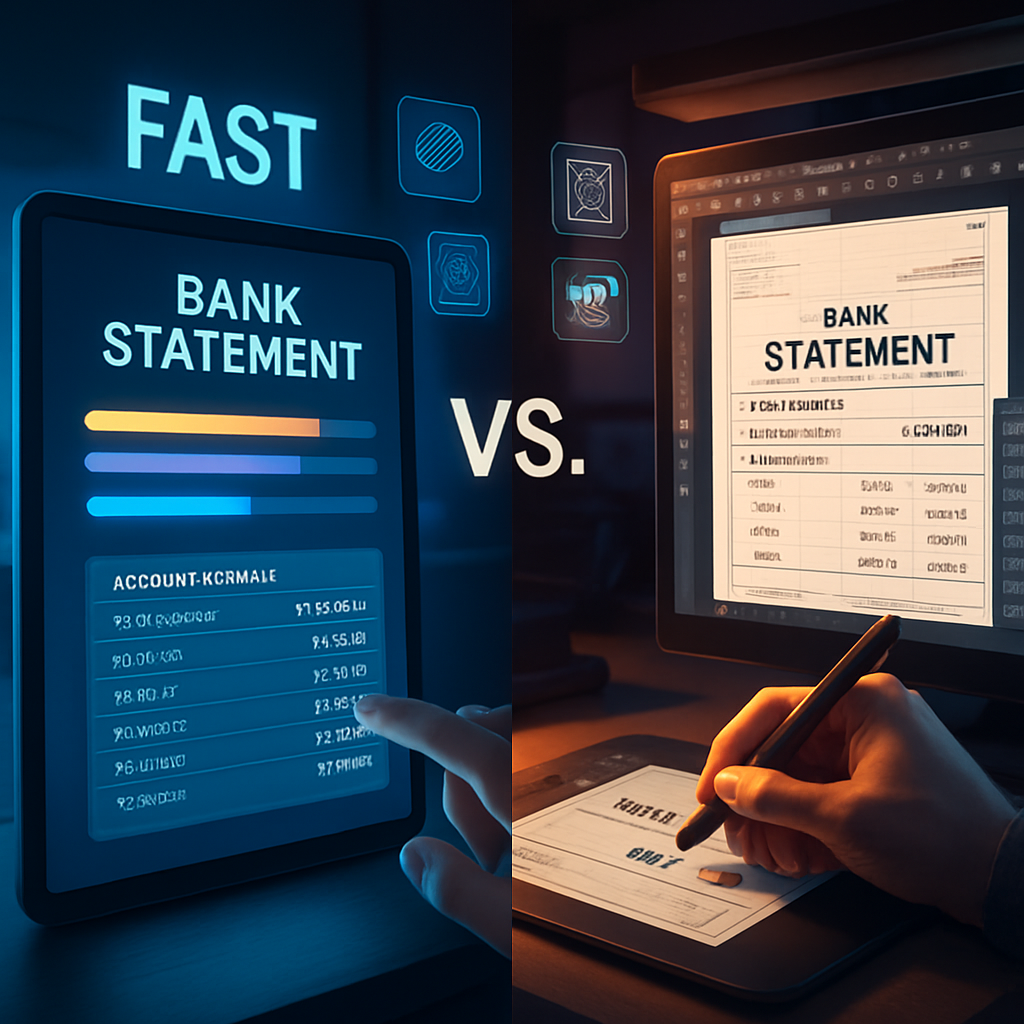
Choosing between a bank statement generator vs template can significantly impact how quickly and accurately you produce financial documents for projects requiring customization and detail. While automated bank statement generators offer speed, they often lack the design flexibility and precise control that editable bank statement templates provide. Using customizable PDFs ensures consistent formatting, cleaner layouts, and pixel-level editing for documents that closely align with authentic standards.
This guide explores the advantages and limitations of both methods, helping you understand how editable PDF templates outperform generators in versatility and customization. You will learn practical tips for adjusting content, improving document quality, and reducing common issues associated with generic generated files. Whether you prioritize fast results or in-depth customization, this comparison offers clear insights into creating effective financial document mockups.
These templates are intended for design practice, mockups, and film props; they are not substitutes for official documents.
Understanding the differences between bank statement generators and editable PDF templates is essential for creating authentic-looking financial documents. This guide highlights the advantages and challenges of each method to help you choose the best tool for your verification needs.
- Compare speed versus customization: Generators offer quick outputs, while editable PDFs provide in-depth control over every document detail.
- Recognize detectability risks: Automated generators often produce fake codes that can be easily flagged by verification systems.
- Leverage pixel-level editing: Editable PDF templates allow precise adjustments to layout and content, enhancing document authenticity.
- Understand pros and cons: Generators are convenient but limited; templates require effort but yield superior customizable results.
- Address common concerns: Learn why editable bank statement templates reduce the chance of detection compared to generic generated files.
- Explore authentic document creation: Use customizable PDFs to craft bank statements that closely replicate real document standards.
- Access reliable template resources: Consider collections of editable PDFs tailored for financial document mockups and verification practice.
Next, we’ll dive into practical tips for customizing editable PDF bank statement templates to maximize their realism and usability. These templates are intended for design practice, mockups, and film props; they are not substitutes for official documents.
Key Differences Between Bank Statement Generators and Editable PDF Templates
Overview of Bank Statement Generators
Bank statement generators are automated tools designed to rapidly produce bank statements with little user intervention. They are optimized for speed and ease, allowing users to generate documents in just a few clicks. However, this convenience often comes at the cost of limited customization capabilities, which can make the generated statements appear generic and less authentic.
Features of Editable Bank Statement Templates
Editable PDF templates, by contrast, empower users with comprehensive control over every design element. These templates facilitate pixel-level adjustments, including fine-tuning of layouts, typography, color schemes, and graphical elements. This granular control ensures that users can craft bank statements that closely mirror the intricate styling of real documents, a crucial aspect when documentary authenticity is a priority.
Comparison of Speed Versus Customization
- Generators: Designed to maximize output speed, typically offering pre-filled fields and templates with limited customizability. Ideal for fast mockups but may sacrifice realism.
- Editable PDFs: Require more hands-on editing and design input, which can extend production time, but deliver superior authenticity through detailed and precise customization.
Understanding these trade-offs informs the choice between templates and generators, paving the way to address detectability risks next.
Detectability Risks and Authenticity Challenges
Common Fake Bank Statement Detection Mechanisms
Verification systems employ multiple strategies to identify suspicious bank statements. They scan for unrealistic layouts, inconsistent fonts or alignments, generic placeholder text, and mismatched date or currency formats. Discrepancies in transaction details or a lack of typical banking security features (like microprint or watermarks) also raise suspicion. These automated checks are geared to flag inconsistencies that commonly appear in artificially produced documents.
How Editable PDF Templates Reduce Detection Risks
Editable PDF templates allow precise replication of authentic bank statement characteristics. By granting pixel-level control, users can adjust layout subtleties, embed realistic fonts, and include legitimate-looking design elements such as bank logos, official seals, and accurate header/footer patterns. This enhanced fidelity significantly lowers the likelihood that automated systems or human reviewers will detect discrepancies typical in generic generator outputs.
Limitations of Automated Generators in Authenticity
- Common generator outputs rely on default templates and fixed data sets, resulting in uniformity that verification algorithms can easily detect.
- Stylistic inconsistencies and oversimplified document structures lead to questions about legitimacy, especially under scrutiny.
Minimizing detection risks through template customization connects naturally to practical tips on how to tailor editable PDF bank statement templates effectively.
Practical Tips to Customize Editable PDF Bank Statement Templates
Adjusting Content for Realistic Appearance
- Transaction Accuracy: Edit transaction dates, descriptions, and amounts to reflect plausible banking activity. Use realistic merchant names and date formats consistent with the statement’s locale.
- Font Consistency: Choose fonts matching those used by the bank and apply uniform font sizes and weights across headings and data fields for a coherent presentation.
- Alignment Precision: Maintain horizontal and vertical alignment, especially in transaction tables, to prevent uneven spacing or misalignment that can betray document fabrication.
Enhancing Layout and Design Elements
Leverage template features such as adjustable grids and snapping tools to align components flawlessly. Customize headers and footers to include bank-specific information, contact details, and disclaimers where appropriate. Assign distinct layers for text, logos, and background elements to facilitate quick edits without disturbing the overall layout balance.
Exporting Clean and Print-Ready Files
When exporting the final version to PDF, choose settings that preserve vector shapes and embed fonts globally. Avoid excessive compression to ensure crisp text and graphic elements. Confirm layer integrity is maintained and that no unintended transparency or artifacting occurs. These practices guarantee the document remains professional and visually authentic in both digital and printed forms.
Explore comprehensive editable bank statement templates collection for diverse design options that support these best practices.
The next section contrasts the pros and cons of these tools for different user scenarios.
Pros and Cons of Bank Statement Generators vs Editable PDFs
Advantages of Bank Statement Generators
- Rapid generation enables instant sample production, useful for fast prototyping or low-stakes mockups.
- Intuitive user interfaces allow anyone to create documents without needing advanced software skills.
Challenges with Generators
- Standardized outputs reduce uniqueness, increasing the chance of detection or skepticism.
- Customization limitations restrict modification to text fields and basic colors, neglecting broader design elements.
Benefits of Editable PDF Bank Statement Templates
- Full creative control over layout and content supports high-fidelity replicas tailored to specific banks and regions.
- Ability to reproduce authentic design features results in documents that better withstand scrutiny.
Drawbacks of Using Editable PDFs
- Requires investment of time and familiarity with graphic design or PDF editing software.
- Manual edits increase risk of errors without careful version control and thorough proofreading.
Discover high-quality, editable bank statement templates such as the 7-page editable bank statement template for enhanced design flexibility and usability.
Before utilizing such tools, however, it’s important to understand the legal and ethical frameworks that govern their use.
Legal & Ethical Use of Editable Bank Statement Templates
- These templates are intended strictly for design practice, mockups, educational purposes, or as props in film and media productions.
- They are not valid substitutes for official financial documents and should never be used for deceptive or fraudulent purposes.
- Users must always comply with applicable laws and avoid improper use that attempts to mislead financial institutions or verification systems.
With legal considerations in mind, selecting the right template for your needs maximizes both efficiency and document integrity.
Best Practices for Selecting Bank Statement Templates
Choosing the Right Template Based on Your Needs
Evaluate your project’s complexity and accuracy requirements before committing to a template. Simpler projects may require fewer customization layers, while advanced applications might demand multi-page documents with comprehensive transaction histories. Prioritize templates that align with your editing skills and final goals.
Utilizing Templates for Various Origins and Banking Formats
Access region- and institution-specific templates to match local banking styles, currency formats, and regulatory standards. For example, templates like the USA bank statement template or the India IDFC First Bank template are tailored to accurately reflect local documentation nuances, fostering higher authenticity.
Maintaining Document Integrity During Editing
- Version Control: Save incremental copies of your document at each edit stage to safeguard against accidental data loss and facilitate rollback when necessary.
- Software Selection: Opt for PDF editors that support embedded fonts, retain layered structures, and offer precise alignment tools to maximize control and output quality.
Conclusion
In summary, navigating the choice between bank statement generators and editable PDF templates hinges on balancing speed with customization. While generators offer rapid document creation suited for quick mockups, their standardized outputs often lack the nuanced detail necessary for more credible representations. Conversely, editable PDF templates provide extensive control over every design element, enabling precise adjustments that significantly enhance document realism and visual fidelity.
Embracing editable bank statement templates unlocks meaningful advantages such as tailored layouts, locale-appropriate formatting, and consistent typography—key factors in producing clean, professional exports that stand up to close examination. The ability to customize content meticulously, align design elements flawlessly, and export high-quality PDFs ensures your documents meet diverse project demands with greater authenticity.
Moving forward, the practical challenge is to integrate these templates thoughtfully into your workflow by selecting designs aligned with your specific needs and mastering editing tools to maintain document integrity. Focus on robust version control and detail-oriented customization to elevate both efficiency and quality. By doing so, you ensure your bank statement mockups remain effective visual tools while respecting ethical and legal guidelines.
These templates are intended for design practice, mockups, and film props; they are not substitutes for official documents.