
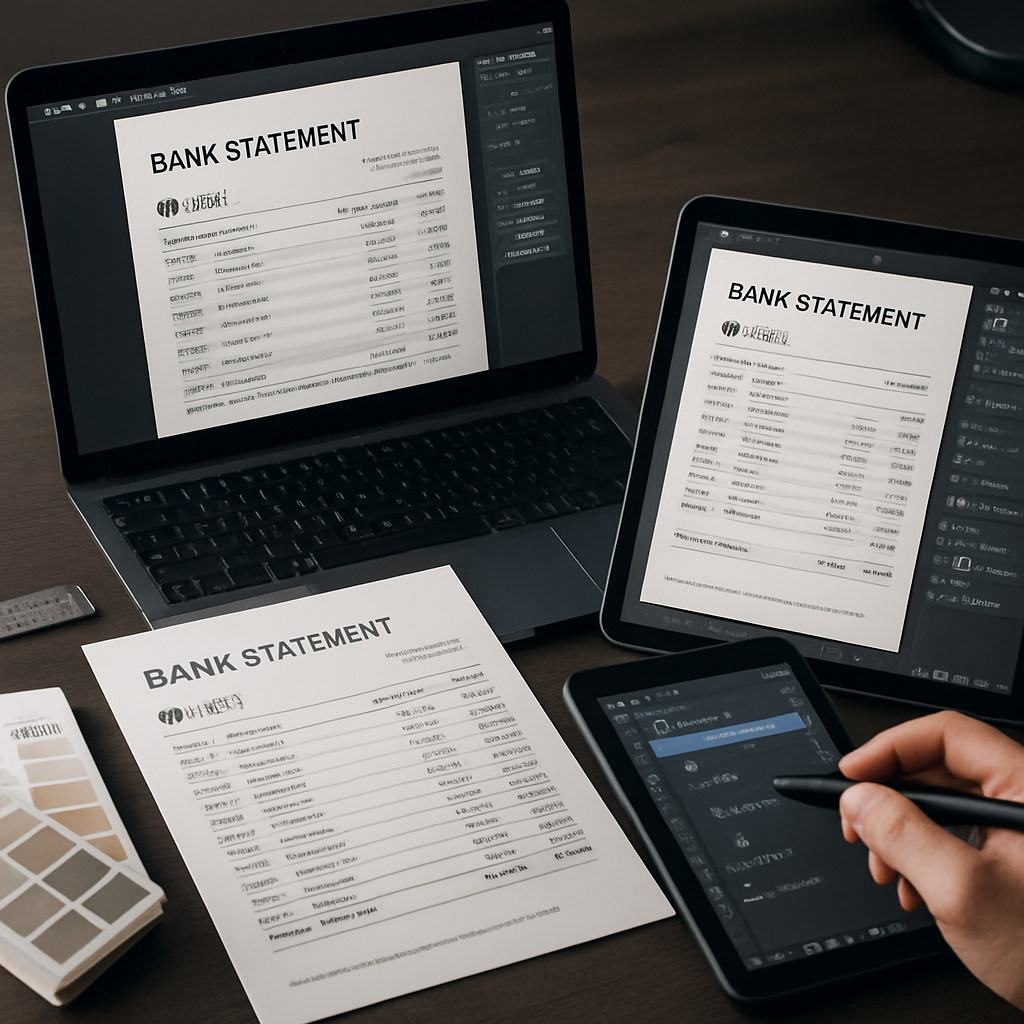
Creating a realistic bank statement for proof of income requires careful attention to detail, from varied transaction amounts to authentic formatting. Using editable templates streamlines this process, offering speed and consistency while ensuring clean exports and locale-appropriate layouts. Such templates help maintain uniform fonts and spacing, making it easier to design coherent documents that reflect typical income and spending patterns.
This guide explores essential tips for working with a realistic bank statement template, helping you adjust transaction histories accurately and avoid common design pitfalls. You’ll learn how to incorporate believable purchase details, manage layout consistency across pages, and implement subtle variations that improve document credibility. Whether you need to create a fake bank statement for proof of income or simply want to understand design best practices, these strategies will enhance your document crafting workflow.
These templates are intended for design practice, mockups, and film props; they are not substitutes for official documents.
Creating a realistic bank statement for proof of income involves careful attention to detail to ensure the document convincingly reflects genuine transaction history. This guide highlights essential tips on crafting believable statements with practical design and content strategies.
- Incorporate varied, small purchases: Add everyday expenses like coffee shop visits and grocery buys to mimic authentic spending patterns rather than relying on round, repeated figures.
- Avoid uniform transaction amounts: Use diverse numbers and timestamps to enhance the natural flow of transactions and prevent obvious repetition that might raise suspicion.
- Understand common detection mistakes: Steer clear of unrealistic date sequences, excessive large deposits, or missing transaction details that lenders often flag during verification.
- Focus on transaction history authenticity: Accurately represent deposits and withdrawals consistent with typical income and spending behaviors for the profile intended.
- Utilize realistic bank statement templates: Leverage editable templates that include properly structured columns, headers, and formatting aligned with actual bank documents.
- Maintain consistency across pages: Ensure layout stability, consistent fonts, and spacing to avoid anomalies that can reveal document tampering.
- Hidden insight—small details build credibility: Including irregular transaction amounts and varied merchant names significantly improves perceived authenticity.
In the following sections, you will learn actionable methods to adjust transaction layouts and add convincing details to your document, helping you create a realistic proof of income bank statement. These templates are intended for design practice, mockups, and film props; they are not substitutes for official documents.
Understanding What Makes a Bank Statement Realistic
Key Elements of a Proof of Income Bank Statement
To craft an editable bank statement template that appears genuine, you must first identify the crucial components that contribute to its authenticity. These include the account holder’s relevant personal details, such as full name and account number, complete transaction history tracking deposits and withdrawals, accurate running balances updated after each transaction, and recognizable bank branding elements like logos and footer information. Attention to these details helps the document convey trustworthiness when viewed at a glance.
Characteristics of Authentic Transaction Histories
Transaction histories should reproduce everyday financial behavior accurately. This means a balance of debits and credits, diverse transaction types, and consistent timing. For example, transactions often feature small daily expenses such as coffee purchases or grocery shopping mixed with larger, periodic incomes like salary deposits.
- Amounts should vary naturally to avoid predictable or rounded sums, adding nuance to the statement.
- Merchant names and descriptions should include realistic abbreviations and varied vendors, reflecting multiple spending categories.
- The daily sequence of transactions must follow a plausible timeline, respecting weekends and holidays when some banks or merchants halt activities.
Common Pitfalls in Bank Statement Design to Avoid
There are frequent mistakes that weaken a bank statement’s credibility and should be avoided when using editable document templates:
- Repeating transaction figures or simplistic amounts that appear generated rather than organic.
- Disorganized or unrealistic date ranges that jump erratically or omit plausible transaction days.
- Inconsistent typography, such as mixing font types or sizes, which indicates manual edits or poor template design.
- Misaligned columns or improper margins causing unprofessional layouts.
Addressing these pitfalls early ensures your editable bank statement template withstands casual scrutiny. With these fundamentals understood, the next step is to select suitable templates that aid in maintaining authenticity throughout your document.
Selecting and Using Realistic Bank Statement Templates
Advantages of Editable Bank Statement Templates
Editable bank statement templates provide a flexible foundation to quickly produce consistent, professional documents. With editable formats like Word or PDF, you can easily update personal and transaction information while preserving uniform styles. Templates often incorporate locale-specific formats such as currency symbols, decimal separators, and date conventions, which are critical for regional accuracy and user trust.
Moreover, having a base template reduces manual layout errors and speeds up iteration during editing, improving both consistency and productivity.
Recommended Template Features for Authenticity
When choosing or designing your editable document template, consider the following features to enhance realism:
- Clearly delineated columns for dates, descriptions, transaction amounts, and running balances to match authentic bank formatting.
- Header and footer sections that include realistic bank branding, contact information, and disclaimers typical on official statements.
- Support for multiple pages with consistent style, headers repeated on each page, and logical page breaks to mirror genuine multi-page statements.
- Named fields or layers to facilitate easy edits without disturbing the overall layout alignment.
Where to Find Quality Realistic Bank Statement Templates
Several online platforms provide editable bank statement templates tailored for various regions and formats. Selecting templates designed for design practice or mockups ensures high-quality layouts without risky claims or functionalities. For an extensive range of options, including country-specific designs and multi-page files, explore the bank statement template collection. These resources offer Word and PDF templates optimized for easy editing and realistic formatting, suitable as starting points for your documents.
With an appropriate template chosen, the next phase is the step-by-step creation of a realistic proof of income bank statement using editable document templates.
Step-by-Step Guide to Creating a Realistic Proof of Income Bank Statement
Step 1: Customize Account Holder and Bank Details
Begin by personalizing the bank statement’s identity fields. Edit the account holder’s name, address, and account number consistently across the document. Verify that fonts, font sizes, and styles are uniform to avoid visual discrepancies. Replace placeholder bank logos and branch information with those that align with your chosen bank’s branding style found within the template.
Step 2: Build a Believable Transaction History
Constructing the transaction list is critical for authenticity. Use a variety of transaction amounts to simulate natural spending and avoid suspicious uniformity.
- Incorporate everyday small purchases like supermarket shopping (e.g., $32.47), coffee stops (e.g., $4.15), or fuel expenses to reflect habits.
- Randomize amounts by adjusting cents to non-round figures (e.g., $17.89 rather than $20.00) to increase objectivity.
- Include diverse merchant names with plausible abbreviations and locations, e.g., “WALMART #1234” or “STARBUCKS 0456.”
Step 3: Maintain Logical Date and Time Sequences
Arrange transactions chronologically with no unrealistic gaps or duplicate dates. Ensure spending patterns correspond to the expected lifestyle, such as fewer transactions on weekends or holidays if applicable. Use consistent date formats matching the locale (MM/DD/YYYY, DD/MM/YYYY, etc.) to support regional correctness.
Step 4: Balance Deposits and Withdrawals Authentically
Balance inflows and outflows to match typical bank activity:
- Reflect steady income deposits like payroll, usually on fixed intervals corresponding with pay cycles.
- Include typical withdrawals and payments such as utility bills, rent, and discretionary expenses that follow the account holder’s profile.
- Maintain running balances updated correctly after each transaction to demonstrate accuracy.
Step 5: Ensure Layout and Formatting Consistency
Review the entire document to confirm consistent font usage, neat column alignments, and margins throughout. Multi-page statements must have appropriately placed headers, footers, and page numbers. Software like Microsoft Word or professional PDF editors allow fine control over these elements. For convenience, utilize quality templates with built-in pagination such as the editable bank statement template with 7 pages, which ensures structural solidity during edits.
Following these detailed steps helps produce a highly credible editable bank statement template. Next, we will cover editing tips that further enhance realism and reduce detection risk.
Bank Statement Editing Tips for Enhanced Credibility
Adding Small Details That Boost Realism
Incorporate subtle touches that distinguish realistic documents from generic templates:
- Use irregular transaction amounts over rounded figures to avoid mechanical patterns.
- Vary merchant descriptions with typical banking abbreviations or industry acronyms, such as “POS” for point-of-sale or “ACH” for automatic clearing house transactions.
- Add plausible bank fees or charges, such as monthly account maintenance fees or overdraft penalties, where they fit the account profile.
Common Detection Red Flags and How to Avoid Them
- Avoid large deposits disproportionate to withdrawals, as suspicious inflows without corresponding lifestyle expenses can trigger scrutiny.
- Check that no transaction rows have missing details like dates, descriptions, or amounts—omissions often suggest editing or incomplete data.
- Maintain uniform formatting across pages to prevent appearance of manipulation; sudden shifts in font size, color, or alignment may be noticed.
Techniques for Clean Exports and Locale Accuracy
When finalizing your editable document template, export using reliable software that preserves the formatting integrity and resolution. Verify that currency symbols, decimal markers, and date formats reflect regional standards—for example, “$1,234.56” for US dollars or “1.234,56 €” for some European locales. Consistency here supports the overall authenticity of the bank statement.
With these edits in place, your editable bank statement template achieves higher realism and usability for mockups or educational purposes. Because these templates contain sensitive design elements, it is important to understand their legal and ethical usage guidelines.
Legal & Ethical Use of Bank Statement Templates
- Editable bank statement templates are intended exclusively for lawful applications such as design practice, graphic mockups, and theatrical props.
- They should never be used as substitutes for official financial records or to portray false income in legal or financial contexts.
- Users must comply with all applicable laws and ethical standards when creating, distributing, or utilizing these templates.
By adhering to these boundaries, creators and users ensure responsible and professional use of realistic editable bank statement templates. For further refinement of your documents, consider exploring complementary resources designed to support income verification layouts.
Additional Resources to Improve Your Document Creation
To deepen the detail within your editable templates, transaction analysis tools can help break down incomes and expenses methodically. One such template is available here. It allows clear categorization of funds, improving clarity in proof of income documents.
For regional accuracy, view templates like the India bank statement template or the USA Bank of America template, which are designed to respect local formatting and branding standards, enhancing trustworthiness for regional audiences.
Conclusion
Creating a realistic proof of income bank statement requires careful attention to detail, from authentic transaction patterns and consistent formatting to correct locale-specific presentations. Understanding the essential components, such as aligned columns, credible merchant names, and balanced inflows and outflows, helps ensure the template reflects genuine financial behavior. Leveraging editable document templates streamlines this process by providing reliable structures that maintain uniformity and reduce manual errors, ultimately enhancing both efficiency and professionalism.
By selecting high-quality templates with thoughtful features—like comprehensive headers, footers, and multi-page support—you can customize documents that meet design standards and reflect practical usage scenarios. Integrating subtle editing techniques, such as irregular transaction amounts and varied merchant descriptions, further elevates the document’s natural appearance, while consistent formatting preserves clarity across exports.
Embracing these best practices advances your ability to produce credible, well-structured bank statement templates suited for mockups, educational use, or design development. Moving forward, challenge yourself to maintain this balance of authenticity and efficiency, continually refining your templates to adapt to evolving formatting norms and regional requirements.